


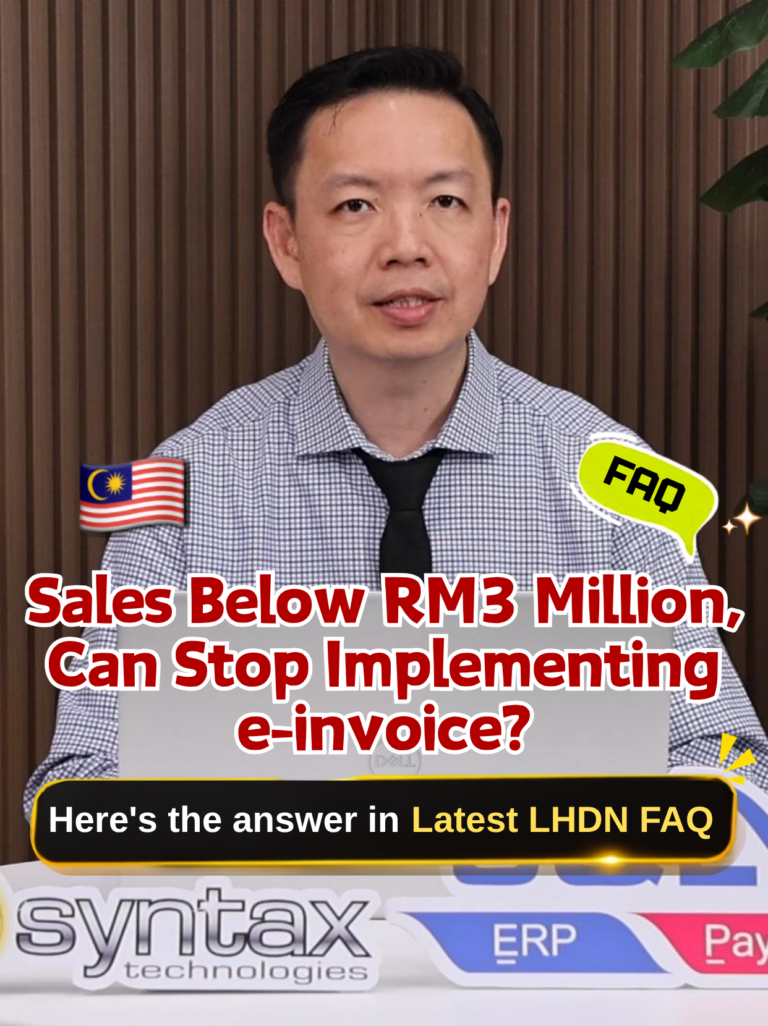
A written companion to Bryan Cheong’s original video or pictures. Updated by Syntax Technologies on 28 September 2026.
A business below RM3 million may stop issuing e-Invoices if it qualifies for the revised exemption. However, a later drop in turnover does not automatically remove an obligation once its mandatory implementation year has been determined.
These are different situations. In this video, Bryan Cheong explains ten points from LHDN’s September 2026 FAQ. This guide follows the video and links to the official FAQ updated on 4 September 2026 so you can check the conditions that apply to your business.
1. Check the revenue history, not only this month’s sales
Bryan first separates businesses already operating in YA2022 from those that started in YA2023–YA2025. For the scenarios he discusses, reaching RM3 million in YA2023, YA2024 or YA2025 leads to a 1 July 2026 implementation date.
For an otherwise exempt business first reaching the threshold in YA2026 or a later year, the video explains the date as 1 January of the second year after that year of assessment. Its example is reaching the threshold in 2026 and starting on 1 January 2028. Confirm the correct year of assessment and exemption criteria before using this example.
2. Distinguish the revised exemption from a later revenue decline
Some businesses started under the earlier RM1 million threshold but qualify for exemption after the change to RM3 million. Bryan explains that qualifying taxpayers in the FAQ examples can discontinue without a separate application or prior approval.
This is different from a business that has crossed the applicable threshold and had its mandatory implementation year determined. Bryan’s seventh point explains that a subsequent fall below RM3 million does not restore exemption. Do not decide to switch off submissions simply because the latest sales report is lower.
3. Review shareholders, holding companies and related businesses
The video highlights three possible exclusions from the exemption: a relevant non-individual shareholder, a holding company, or a related company/joint venture with annual turnover or revenue of at least RM3 million.
Prepare your ownership structure and the relevant entities’ revenue figures. The term “related company” has a specific meaning; the answer is not determined just by calling businesses part of the same group.
4. Treat sole proprietorships and companies correctly
Bryan distinguishes multiple sole-proprietor businesses registered to the same individual from separately incorporated companies. For the former, the owner’s sole-proprietor business revenues are considered together for the threshold.
Companies with a common individual shareholder are not automatically related solely for that reason in the FAQ examples. Corporate ownership and control still require examination. “Same boss” is therefore not enough information to decide whether every business must implement.
5. Check the scope of any relief for omitted e-Invoices
The video discusses the FAQ example of an eligible exempt company that had omitted some e-Invoices. In that example, participation in the e-Invoice Special Voluntary Disclosure Programme is not required. This should not be read as a blanket waiver for every taxpayer or every historical tax issue.
6. Keep responsibility and records clear
Outsourcing the work does not transfer the taxpayer’s compliance responsibility to the software provider or bookkeeper. Agree who prepares, reviews and monitors submissions.
An e-Invoice exemption also does not cancel accounting, tax filing or supporting-record obligations. Continue recording transactions and maintaining the evidence needed for your accounts.
Before changing your e-Invoice workflow
- Compile annual turnover or revenue by relevant year of assessment.
- Record the business commencement date and legal structure.
- Review ownership, control and related-entity conditions.
- Document whether you qualify for the revised exemption or remain mandated.
- Confirm the conclusion with your tax adviser or LHDN, then coordinate any software change with the responsible team.
Common questions
Is RM3 million itself below the threshold?
No. “Below RM3 million” and “at least RM3 million” are different. Check the full annual amount and the relevant assessment rules.
Can an eligible exempt business continue voluntarily?
Yes. The video explains that voluntary continuation remains an option.
See the Chinese explanation and our bilingual guide to the RM3 million update and new-business timing.
Primary content: Bryan Cheong’s embedded video. Regulatory reference: LHDN General FAQ, 4 September 2026, particularly questions 12–20, 99–104. This is general guidance; assess your own facts before changing submissions.
Need help with SQL Accounting or SQL Payroll?
Syntax Technologies provides software sales, training and support. Contact 012-663 9318 or info@syntech.com.my with your software version and the reports or workflow you need help with.